Research for data science and engineering hires
Cruvo researches data scientists and data engineers for the analytical work and data systems your team needs to improve. We clarify the role and return a ranked long-list with career evidence. Your team can compare relevant experience, contact candidates and assess how they would handle the work.
Research services for this hire
Candidate sourcing
Research scientists and engineers against the data responsibilities your team needs to fill.
Explore candidate sourcing →Market mapping
Explore employers with comparable data problems, technical environments and analytical work.
Explore market mapping →Executive search research
Research leaders when the hire needs to build or direct the data function.
Explore executive research →Data roles and responsibilities
The division of data responsibilities
A data science role and a data engineering role need different evidence. We separate analytical and modelling responsibilities from building and maintaining the data systems they depend on.
Technical experience in different settings
The same tools can support very different data volumes, reliability needs and responsibilities. Cruvo relates stack requirements to the systems and work in each candidate’s career.
The purpose of domain knowledge
Subject knowledge can be essential when someone must interpret data. For other jobs, comparable technical work may matter more. We agree that distinction with the hiring team.
The needs of an early team
The support around a data hire changes the job. We clarify what an early team needs someone to handle independently and what an established team already covers.
A long-list organised around data work
The right data discipline
Your brief identifies the main data responsibility, so managers can assess scientific, analytical and engineering backgrounds using criteria appropriate to the work.
Comparable technical context
The reasons in the long-list connect a candidate’s data work and technical environment to the requirements your hiring manager has set.
Useful market knowledge
The company map and candidate history give later searches a starting point as you add new roles to the data team.
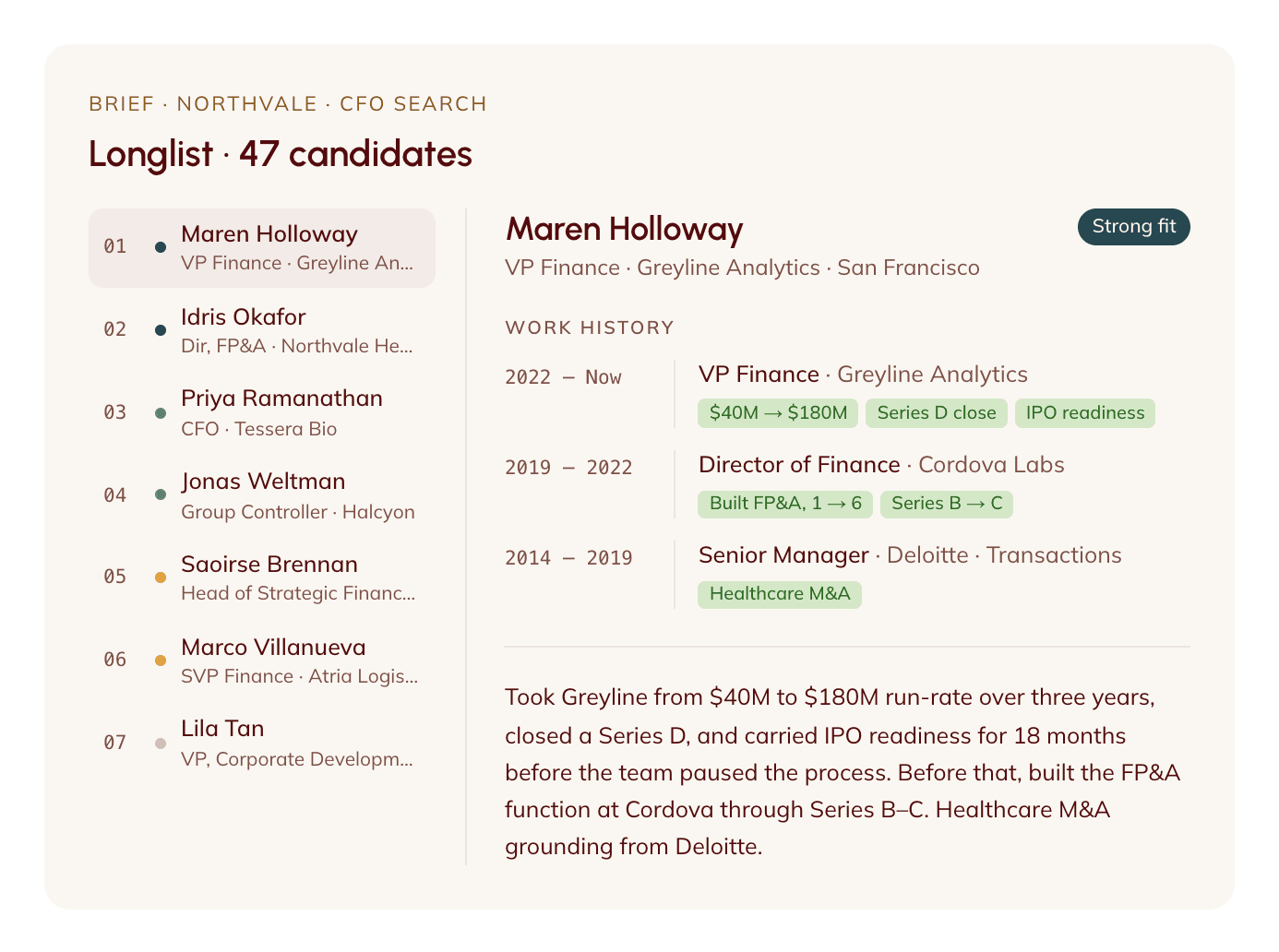
An example of the workspace: ranked candidates with the reasoning behind each name.
The first data hire
Cruvo helps define a first data hire around the work the business needs to do next. If the inputs are unreliable, that may mean building pipelines and organising datasets. If the data is usable, the need may be experiments or analysis.
A single role can cover both, with a clear order of priorities and support from colleagues. That is a different search from hiring a specialist into an established data team.
We agree those responsibilities with your hiring manager and research people who have done relevant work. The long-list explains the fit so your team can choose candidates for assessment.
FAQ
Can you research data scientists and data engineers?
Yes. We research scientists and engineers for the responsibilities in your brief. Science may involve models, experiments and interpretation; engineering may involve pipelines and dependable data access. We return a ranked long-list with reasons for considering each person, so your team can compare the experience relevant to its job.
How do we choose between science and engineering?
The work you need done should guide the choice. Someone may need to collect data and make it reliable, which points towards engineering. With that work covered, you may need modelling or experiments. Cruvo helps clarify those priorities before researching the people who could take responsibility.
Can the search include analytics engineers as well?
Yes. The search can include analytics engineers when the role involves preparing consistent data models for analysis. We discuss who uses that work and how it fits alongside data engineering. Cruvo then researches relevant experience across titles and explains the connection to your brief in the long-list.
How do you account for our data stack?
Your hiring manager sets which technologies are essential and which someone could learn. We use that distinction when researching experience with languages, warehouses and cloud platforms. The list also relates each candidate’s work to the systems they would own, so a tool match has a useful context.
When does sector experience matter for data hiring?
Sector experience matters when it changes how someone interprets the data or handles the job’s constraints. We clarify whether they need that knowledge immediately. If it is a preference, we research adjacent backgrounds too, explaining how their systems and data work relate to the role.
Does Cruvo assess statistics or test coding ability?
Your hiring team assesses statistics and coding. Cruvo researches experience and explains why someone belongs in the candidate list. Your interviews or practical work can then examine their judgement and decisions in detail. The team also confirms interest and availability when it approaches the person about the role.
How does data hiring differ from AI engineering?
The data search covers foundations, analysis and scientific work. AI engineering covers building and operating AI systems. Model deployment can connect the two, so we clarify which work the hire will own. That gives the search a basis for considering relevant people across neighbouring roles.
What remains useful after the current data hire?
The market map and the history of your candidate conversations remain useful. Your CRM includes people your team stars, notes, contacts or adds. Your next search can use that context in the workspace, including what happened when you approached someone and the notes your team recorded.
Talk to us about hiring
Tell us about the data work your team needs to do and the hire you are considering. We can discuss the responsibilities, the experience that matters and how candidate research would help you explore the market.
Or email hello@cruvo.app directly.